From Community Vision to Reality: How the Pikes Peak Recreation Area Came Together
Rosemont Reservoir marks the first milestone in a bold new approach to outdoor recreation on Pikes Peak—and demonstrates what is possible when a region works together toward a shared vision.
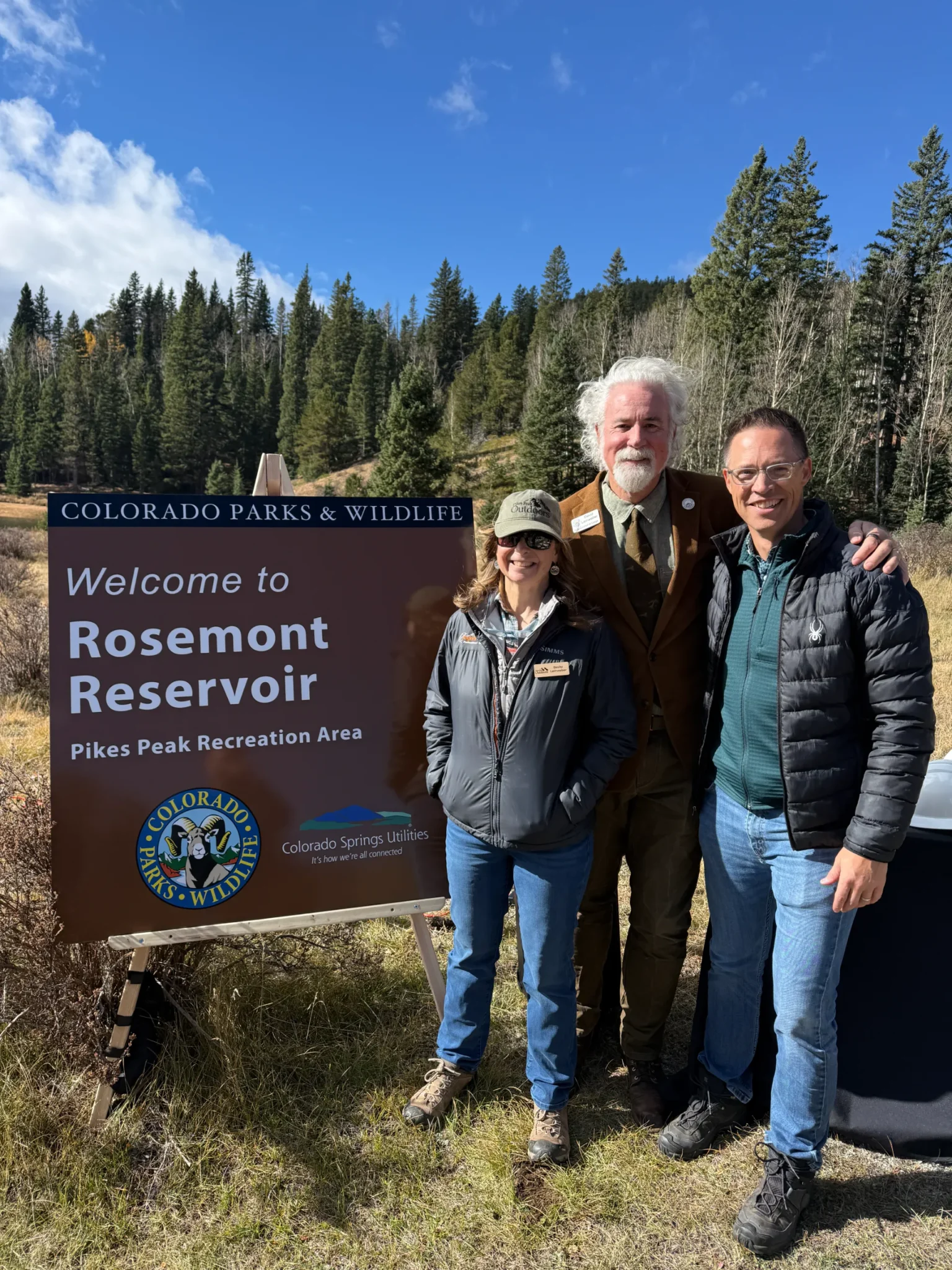
 On October 23, 2026, Governor Polis joined Colorado Parks and Wildlife (CPW), Colorado Springs Utilities, and regional partners gathered at Rosemont Reservoir to celebrate the groundbreaking of new recreation improvements and a significant milestone: the beginning of the Pikes Peak Recreation Area.
For visitors, this means new opportunities to camp, paddle, fish, and enjoy one of Colorado’s most iconic landscapes. For our region, it represents something even bigger—a new era of collaboration among the public land managers responsible for Pikes Peak.
And for Pikes Peak Outdoors, it is an exciting moment to see years of community engagement, regional planning, and partnership-building turn into meaningful improvements on the ground.
This is what happens when we listen to our community, dream big, solve problems, and work together.
It Started with Listening
In 2021, Pikes Peak Outdoors, then known as the Pikes Peak Outdoor Recreation Alliance, was selected as one of Colorado’s first four Outdoor Regional Partnerships, an initiative supported by Colorado Parks and Wildlife and Great Outdoors Colorado.
That designation helped launch the Outdoor Pikes Peak Initiative (OPPI), an ambitious, nearly four-year effort to create a shared vision for outdoor recreation and conservation across El Paso, Teller, and Fremont counties.
Rather than starting with a predetermined list of projects, we started by listening.
Through community listening sessions, surveys, stakeholder conversations, research, and collaboration with land managers, we asked residents, recreationists, businesses, conservation organizations, and community leaders what they wanted for the future of our outdoors.
We heard strong support for protecting forests and watersheds, improving trails and recreation opportunities, expanding responsible access, completing important trail connections such as Ring the Peak, and addressing the growing pressures on our public lands.
But one message came through particularly clearly: People wanted land managers to work together more effectively to provide a seamless, well-managed outdoor experience across the region.
That aspiration was especially important on Pikes Peak.
One Mountain. Many Land Managers. A Shared Opportunity.
Pikes Peak is one of our region’s greatest natural assets, drawing residents and visitors to its trails, forests, reservoirs, campgrounds, and extraordinary scenery.
Yet managing recreation on the mountain is remarkably complex.
The landscape crosses multiple jurisdictions, including federal, state, county, municipal, and utility-managed lands. Each agency has its own responsibilities, resources, regulations, and priorities.
For visitors, those jurisdictional boundaries are largely invisible. People experience one mountain, even though the agencies responsible for managing it operate under different authorities.
As visitation and recreation demands increase, this complexity creates challenges for visitor services, maintenance, enforcement, conservation, and long-term funding.
At the groundbreaking, Governor Jared Polis emphasized the historic nature of the cooperation among the mountain’s many landowners and managers. He noted that visitors don’t experience Pikes Peak according to property boundaries; they simply want to enjoy the mountain. The challenge—and opportunity—is to make recreation more accessible while protecting the landscape and wildlife that make it special.
Through OPPI, Pikes Peak Outdoors brought land managers and community stakeholders together to explore a different approach.
The initiative examined 16 recreation management models from across the country, narrowed those options to four, then one, and brought the leading concept back to the public for feedback.
Ultimately, a collaborative recreation area model, informed by Colorado’s successful Arkansas Headwaters Recreation Area, emerged as the preferred direction worthy of exploration.
Rather than transferring ownership or creating another layer of government, the concept would allow participating land managers to retain their responsibilities while working together with Colorado Parks and Wildlife to coordinate recreation management. The model leverages the strengths of each land manager to complement those of others in a collaborative approach.
It was an ambitious idea, but one grounded in practical solutions and the community’s expressed priorities.
Turning a Shared Vision into Action
When the Outdoor Pikes Peak Initiative Vision Plan was released in August 2025, it provided more than a roadmap for future recreation and conservation investments.
It established a shared direction for the region, identifying 30 priority projects and initiatives and creating a foundation for sustained collaboration.
The proposed collaborative management approach for Pikes Peak was one of its most significant opportunities.
From there, land managers took the next critical steps.
Participating agencies formally requested that Colorado Parks and Wildlife explore a collaborative management role on the mountain. Continued coordination led to a memorandum of understanding among land management partners and CPW, establishing a framework for moving forward together.
At the groundbreaking, Teller County Commissioner Dan Williams described the Pikes Peak Recreation Area as an example of regional partnerships working as intended.
“I believe the work here will provide the true north or the north star for all of Colorado,” Williams said.
He emphasized the value of bringing local, state, and federal partners together to share responsibilities, resources, and the costs of managing recreation—particularly for rural counties with limited budgets.
His remarks underscored the significance of this milestone: the partnership is not only creating new recreation opportunities on Pikes Peak, but also demonstrating a collaborative approach that could serve as a model elsewhere in Colorado.
CPW has now established a dedicated Pikes Peak Recreation Area management role, with Amy Brandenburg serving as Park Manager.
The vision is to improve coordination of recreation services, visitor management, stewardship, and operations across participating properties while respecting each land manager’s individual authority and responsibilities.
This is a major step toward making the public’s vision a reality.
Rosemont Reservoir: The First Visible Milestone
The groundbreaking at Rosemont Reservoir represents the first tangible implementation of this larger effort.
Through an agreement between Colorado Springs Utilities and CPW, Rosemont will become the first property in the newly established Pikes Peak Recreation Area.
Planned improvements include new camping opportunities, day-use parking, access for hand-launched, non-motorized watercraft, and an accessible restroom.
These improvements will expand opportunities for people to enjoy the mountain while continuing to protect the reservoir’s critical water supply functions and surrounding natural resources.
And Rosemont is only the beginning.
Another nearby property is advancing toward inclusion, with additional opportunities under consideration as the partnership works toward a broader, long-term management framework.
The Pikes Peak Recreation Area is not envisioned as a single park with one entrance. It is a collaborative approach to managing recreation across a connected landscape—one that can grow over time as partners identify appropriate opportunities.
Why This Matters for Our Region
The significance of the Pikes Peak Recreation Area extends well beyond new campsites or improved access to a reservoir.
It offers a model for addressing some of our region’s most important challenges and opportunities.
For residents and visitors, it means the potential for more consistent recreation services, better information, improved facilities, and a more seamless experience across the mountain.
For natural resources, it creates opportunities for coordinated stewardship, watershed protection, responsible recreation, and management of growing visitation pressures.
Colorado Springs Utilities CEO Travas Deal emphasized how this partnership can expand recreation while strengthening protection of the watershed that supplies drinking water to Colorado Springs.
“We’re actually increasing recreation but we’re actually increasing security at the same time,” Deal said.
With Colorado Parks and Wildlife providing dedicated recreation management and oversight, the partnership can reduce risks, improve stewardship, and create new opportunities for people to experience the mountain—all while protecting a critical community water resource.
For our outdoor economy, it strengthens the infrastructure and experiences that make the Pikes Peak region an exceptional place to live, work, visit, and do business.
For our public agencies, it provides a framework to share expertise, coordinate investments, and address challenges that no single land manager can solve alone.
For future investment, establishing a state recreation area creates new opportunities to attract resources from the state and other funding partners for thoughtful planning, infrastructure, conservation, and long-term management. Colorado’s newest state parks demonstrate how these partnerships can bring substantial investment to important landscapes while balancing recreation with natural resource protection.
Fishers Peak State Park near Trinidad offers an inspiring example. Through collaboration among Colorado Parks and Wildlife, Great Outdoors Colorado, the City of Trinidad, The Nature Conservancy, the Trust for Public Land, and other partners, millions of dollars have been invested in acquiring, protecting, planning, and developing this remarkable landscape. Its phased approach demonstrates how careful planning, conservation priorities, community engagement, and sustained investment can work together to create exceptional recreation opportunities.
While the Pikes Peak Recreation Area has a different ownership and management structure, it offers similar potential to attract investment, strengthen partnerships, and build the infrastructure and management capacity needed for long-term success.
Perhaps most importantly, it demonstrates that meaningful progress is possible when organizations work across traditional boundaries toward shared goals.
A Milestone Worth Celebrating—and a Vision Still Unfolding
Pikes Peak Outdoors is proud to have helped lead the work that brought our region to this moment.
Our role has been to convene partners, elevate the public’s voice, explore solutions, build consensus, attract funding, and help turn a bold regional vision into a pathway for action.
But this achievement belongs to a much larger community.
We are grateful to Colorado Parks and Wildlife, Colorado Springs Utilities, the participating land managers, Great Outdoors Colorado, our many partners, and the residents who helped shape the Outdoor Pikes Peak Initiative and are working toward its implementation.
Their willingness to collaborate, innovate, and stay committed to a shared vision is what makes this milestone possible.
And there is much more to come.
The Pikes Peak Recreation Area is one of many priorities emerging from the Outdoor Pikes Peak Initiative, alongside efforts to improve trails, strengthen stewardship, protect natural resources, and expand responsible recreation opportunities throughout our three-county region.
On Friday, we celebrated a groundbreaking. But what we are really celebrating is the power of a community’s vision becoming reality.
One mountain. A shared vision. A new era of collaboration.