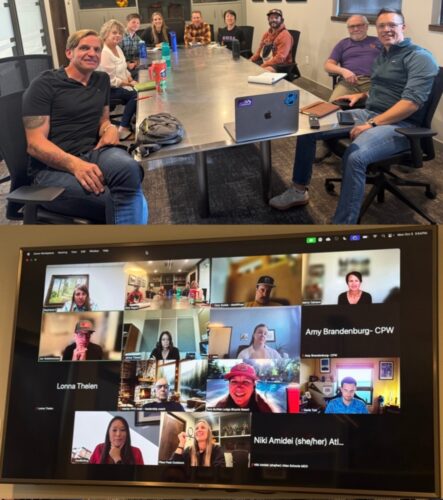
What IMBA walked through
Marty gave the overview. Joe added the rider’s-eye view: Marty rides cross-country and backcountry, Joe rides gravity, and the badge system exists so both of them can tell what a destination actually offers.
- Ride Center is the tourism designation. Trail Town is the resident designation. They can coexist, but marketing both is harder. Marty said Colorado Springs is a Ride Center conversation, not a Trail Town one.
- The new Ride Center test is a mileage requirement plus four badges. More badges means more variety. The old bronze / silver / gold labels are going away.
- Frontcountry — close enough for an after-work ride, an arrival-day lap, or a family outing.
- Backcountry — a longer, harder day and a real immersion in the landscape.
- Gravity — two ways to earn it. One is laps in a single trail system, downhill-focused, across abilities. The other is an iconic long descent. Marty cited the Pikes Peak descent he knows as Elk Park, and a marquee ride in the spirit of Monarch Crest.
- Bike park — a municipal skills park, not a ski-area bike park. Skills features, a jump line, a slopestyle-type course.
- Ride Center is the broader tier. Premier Ride Center is the top tier, all four badges. On the old list of about 24 centers, Joe’s rough guess was two-thirds at Ride Center and one-third at Premier. He was clear those assessments are mostly more than five years old.
- The site visit checks whether the paper inventory is real: well built, maintained, and signed; people can find their way; visitors can find hotels, food, breweries, and coffee. They observe those amenities. They do not audit them. They also look for a community that can keep the trails up. Two local trail organizations in the room was noted as a plus.
- Across the whole destination they want something for every ability. That mix matters most in frontcountry. Backcountry can lean intermediate and advanced because a lot of it is older trail.
How a community gets there
- Someone fills out the application. Marty assumed Cory and Nick would lead it, and said IMBA will work with anyone who wants in.
- IMBA does a desktop review first. There is a small fee for that review. It comes back with whether the community appears to qualify, and at what level.
- The full fee is not owed until the in-person assessment. Joe was explicit about that.
- Colorado Springs would be a pilot. IMBA wants two pilots this fall. The fee is discounted because the community is helping them tighten the process. If both pass, the public relaunch is early 2027, with these two as the first new Ride Centers. End of 2026 is too tight, and weather is a factor.
- If Cory and Nick move quickly, Marty said they may still be able to visit before winter riding gets difficult. If the group wants more conversation first, keep IMBA posted. Marty will send the application.
- Filling out the application is useful even if the group later stops. It is a gap analysis: which badges are thin, and what visitors and locals are missing.
- An extra badge earned later is an upgrade, not a new application, and there is no added fee.
- The designation lasts five years. Recertification is about half the original price and a shorter review, because the file already exists.
Trail Town, and the rest of the region
- Trail Town is for a community still building its trail system. The bar Marty gave was 25 miles or more, a desktop review only, and no site visit. It celebrates a place to live, work, and play. Tourism is not the point, even if some towns use it that way.
- About 28 Trail Towns came out of the first round. The next round opens next month. Ride Center is meant to stay a much smaller list.
- The room had already passed the Trail Town definition around, and the reply on the call was that Ride Center is the right step.
- Cañon City came up as a Fremont County town that is part of the Pikes Peak region but too far out to fold into this Ride Center. Becky and Nick described PPO’s geography: El Paso, Teller, and Fremont, treated by residents and visitors as one landscape. Marty’s comparison was New Castle, which earned its own Trail Town designation even though riders treat it as part of a larger region. Cañon City could do the same. That is a separate decision from this application.
Marketing, and what IMBA will not do
- The benefits document would not open from Dropbox during the call. Marty will send it. It covers what IMBA can offer on marketing.
- IMBA’s expertise is the trails and the designation. They are not a destination marketing organization. They will market the program and the centers they award. The goal is that Colorado Springs becomes recognizable on its own.
- Trailforks is the partnership that matters now, because that is where riders look. The current Ride Center page still shows the old bronze / silver / gold centers. It will be rebuilt for the new badges, the new copy, and the new centers. Existing centers get a year to find their place in the new program. They are not dropped at launch.
- Outside, Trailforks’ parent, may eventually help point riders to these destinations. That offer is not built yet.
- The Ride Center page has stayed one of the most visited pages on IMBA’s site even while the program was dormant. Trail Town announcements drew coverage outside the mountain bike press. They expect a designation to lift attention. They do not have current traffic numbers worth citing.
Questions from the room
- Boise and Tucson were offered as comps. Marty does not have a clean before-and-after from the old program. Aspen Snowmass, a gold center, has used the designation both for visitors and to keep trail work in front of local decision-makers. Marty can try to make an introduction. Joe’s framing: Moab and Bentonville do not need this. The value is the tier just under them. Bentonville is on the old list as silver and would likely grade higher now. It is not clear they will apply.
- Epic rides are a different program. It has been dormant since COVID. IMBA intends to bring it back after Ride Center, and the two will not be tied together. A Ride Center can contain an Epic. An Epic is one route. A Ride Center is a place with a range of riding. One participant said an Epic listing is what got them to a trailhead in North Georgia.
- Other trail users. Improvements for bikes should help hikers and runners too. IMBA agreed, and so have chapters such as Medicine Wheel. They do not have good data from the old program and intend to collect it. A related data point from IMBA’s planning work: about 35 community plans a year, and 25 of the 35 this year were trails for all users, not mountain bikes alone.
- The radius is 30 minutes, not 30 miles. The community drops the pin. It does not have to be downtown. The clock runs to trailhead parking under normal conditions, not rush hour. Trails that leave that trailhead count. Forest Service trails can count when the formal, legal trailhead is the access point, even if a downtown pin would miss them. Choosing the pin is part of the application. Cory and Mike were named as the people who will know the inventory.
- Trail flexibility. Stephanie asked whether frontcountry and backcountry are rigid. Her point was that Colorado Springs is a city and a very large landscape, and a lot of municipal trails sit between those labels. Marty’s answer: the line has gotten blurry, and the site visit is partly there to judge the spirit of the ride. Joe added that IMBA will be flexible about how segments are grouped, because the community’s interest is earning as many badges as the trails support. They will not relabel a blue trail as a black trail to make a badge work. Backcountry still has a minimum distance. The community proposes the trail list, and the grouping, before anyone flies in.